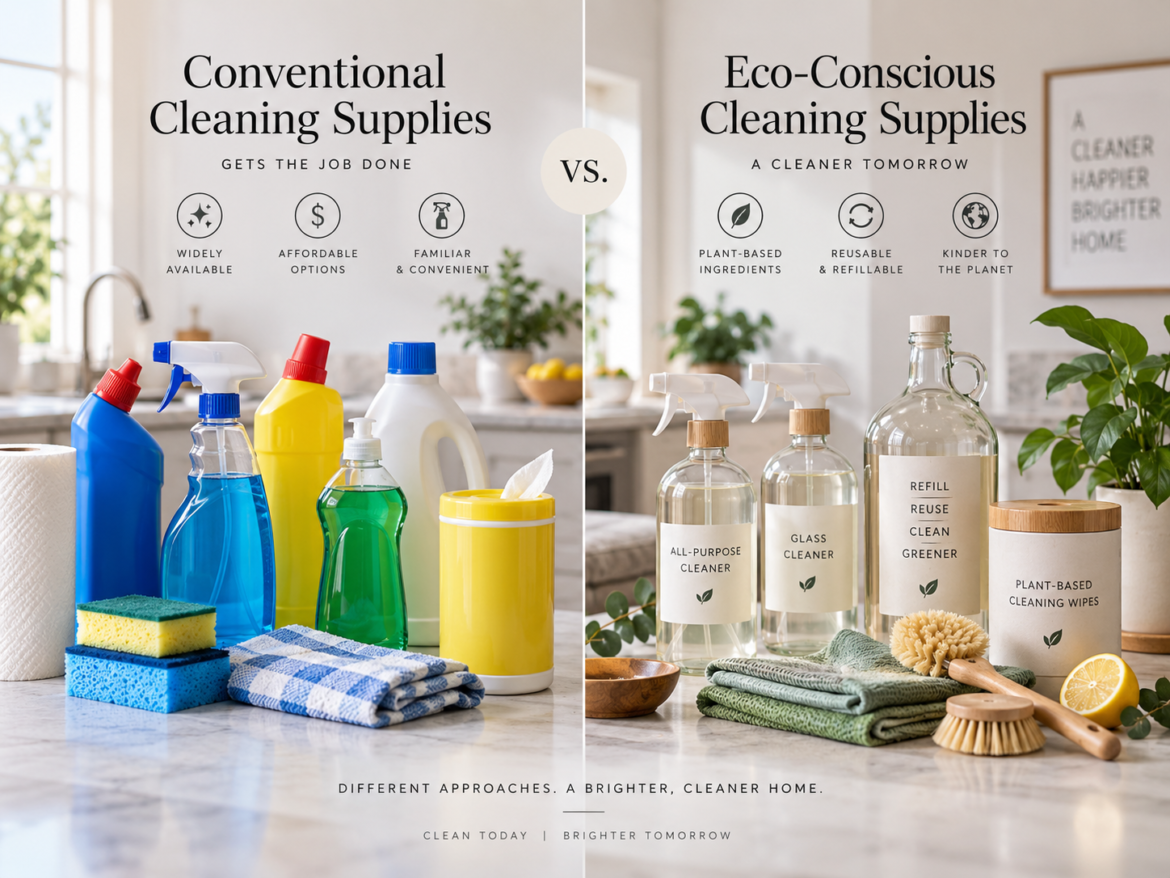
Walk down the cleaning aisle and you will see a lot of labels.
Plant-based. Natural. Green. Eco-friendly. Heavy-duty. Disinfecting. Professional strength.
Those labels can make it seem like homeowners are choosing between two completely different ideas of cleaning:
eco-friendly cleaning or “regular” cleaning.
In reality, the difference is more nuanced.
Both eco-conscious and conventional cleaning products can remove everyday dirt and buildup when they are properly formulated and used for the right job. The more useful questions are:
- What is the product designed to do?
- Is it appropriate for the surface?
- Does it need to clean, sanitize, or disinfect?
- What ingredients and environmental considerations matter to you?
- Are the claims on the bottle independently verified?
At LuxeGlow EcoClean, our approach is not based on the idea that stronger chemicals automatically mean better cleaning.
It is based on choosing cleaning methods and products thoughtfully, matching them to the home, the surface, and the actual task.
Key Takeaways
- Eco-friendly cleaning products can be effective, but they are not automatically better or safer than conventional cleaners.
- Choosing the right cleaner depends on the specific task and surface, not just the label claims like ‘green’ or ‘natural.’
- Disinfecting and cleaning have different purposes; routine cleaning is often sufficient for most households.
- It’s essential to assess product effectiveness based on independent certifications like EPA Safer Choice, rather than relying solely on marketing terms.
- Eco-conscious cleaning involves thoughtful product choices and methods, enabling homeowners to find effective solutions without compromising safety.
Table of contents
- What Does “Eco-Friendly Cleaning” Actually Mean?
- What Is the Difference Between Cleaning and Disinfecting?
- Do Eco-Friendly Cleaning Products Actually Work?
- Are Conventional Cleaners Stronger?
- Is Eco-Friendly Cleaning Safer?
- Does Eco-Friendly Cleaning Mean “Chemical-Free”?
- What Should You Look for on an Eco-Friendly Cleaning Product?
- Does Packaging Matter Too?
- Is Eco-Friendly Cleaning More Expensive?
- When Does Disinfection Make Sense?
- Which Cleaning Approach Is Better for Everyday Home Care?
- What About Homes With Children or Pets?
- Eco-Friendly vs. Regular Cleaning: Which Should You Choose?
- Frequently Asked Questions
- Effective Cleaning Does Not Have to Be an Either-Or Choice
What Does “Eco-Friendly Cleaning” Actually Mean?
There is no single recipe that makes every eco-friendly cleaning product the same.
Some products rely on different surfactants, acids, enzymes, oxidizers, or other cleaning ingredients. Others focus on concentrated formulas, refill systems, fragrance choices, packaging, or ingredient-selection standards.
That is why the words on the front of the bottle should not be the only thing you consider.
A product marketed as “green” may still be very different from another product using the same description.
One useful reference point is the EPA’s Safer Choice program. Products carrying the Safer Choice label must meet EPA requirements for the product and its ingredients. EPA evaluates ingredients within their functional classes against human-health and environmental criteria while also maintaining product-performance requirements.
That gives homeowners something more meaningful to evaluate than a leaf graphic or the word “natural.”
What Is the Difference Between Cleaning and Disinfecting?
This is one of the most important distinctions in the eco-versus-conventional conversation.
Cleaning and disinfecting are not the same thing.
Cleaning removes dirt, organic matter, and many germs from a surface using soap, detergent, water, and physical action.
Sanitizing reduces germs to a specified level.
Disinfecting uses an antimicrobial product intended to kill viruses or bacteria on surfaces.
EPA regulates products that make sanitizing or disinfecting claims, and those products must be used according to their labels, including any required contact time.
For everyday household maintenance, homeowners do not necessarily need to disinfect every surface.
CDC guidance says routine cleaning is generally enough in most household situations. Additional disinfection becomes more relevant when someone is sick or when there is another specific reason to reduce the spread of illness.
That distinction matters because homeowners sometimes assume that a product is “better” simply because it sounds stronger.
Stronger is not automatically better.
The correct product is the one suited to the task.
Do Eco-Friendly Cleaning Products Actually Work?
They can.
But “eco-friendly” by itself does not guarantee performance any more than “professional strength” does.
A well-formulated cleaning product should be evaluated on whether it performs the job it claims to perform.
For example, Green Seal’s GS-37 standard for institutional cleaning products includes performance requirements in addition to health and environmental criteria. Products covered by the standard must demonstrate effective cleaning for the category in which they are certified.
That is an important point.
A credible eco-conscious approach should not require homeowners to accept a visibly lower standard of clean.
At the same time, no single cleaner is ideal for every situation.
A product that performs well on everyday kitchen residue may not be the right choice for mineral buildup.
A bathroom product may not be suitable for a delicate natural-stone surface.
An all-purpose cleaner is not automatically a disinfectant.
The question should be:
What is this product designed to accomplish on this particular surface?
Are Conventional Cleaners Stronger?
Sometimes a conventional product may be formulated for a more aggressive or specialized task.
That does not make the entire conventional category “better,” and it does not mean more aggressive chemistry should automatically be the first choice.
Cleaning involves several variables:
- product formulation
- dilution
- dwell or contact time
- surface material
- amount and type of buildup
- cleaning tools
- mechanical action
- how frequently the area is maintained
When buildup has been allowed to accumulate for a long time, the solution is not always “use something harsher.”
Sometimes the surface needs more time, the correct technique, a different product, or realistic expectations about what cleaning can actually change.
Permanent staining, etching, worn finishes, or damaged materials may not be removable through cleaning at all.
That is why product selection should start with the surface and the problem, not simply with the strongest bottle available.
Where Does Steam Cleaning Fit Into Eco-Friendly Home Care?
Eco-conscious cleaning is not limited to choosing one type of cleaning product over another.
Sometimes the cleaning method matters just as much.
Steam cleaning uses heat and moisture rather than relying entirely on added cleaning products, which can make it a useful option for certain cleaning tasks and compatible surfaces.
That does not mean steam is appropriate everywhere.
Different flooring, finishes, fabrics, and other materials can respond differently to heat and moisture, so surface compatibility and manufacturer guidance still matter.
Steam should also not automatically be described as “disinfecting” simply because it is hot. If sanitizing or disinfecting is the goal, the equipment, surface, temperature, exposure time, and manufacturer instructions all matter.
The larger point is that eco-conscious cleaning does not have to mean simply replacing a conventional bottle with a greener bottle.
It can also mean asking:
Can this surface be cleaned effectively with a different method, less product, or less aggressive chemistry?
That is another example of why the right cleaning approach begins with the surface and the task rather than assuming one method is best for every home.
Is Eco-Friendly Cleaning Safer?
“Safer” requires context.
No cleaning product should automatically be treated as harmless simply because it is described as natural, plant-based, or eco-friendly.
Products can still irritate skin or eyes. Fragrances can matter to some households. Concentrated formulas still need to be diluted and handled correctly. Disinfectants still need label directions followed.
The advantage of programs such as EPA Safer Choice is that they evaluate ingredients against defined human-health and environmental criteria instead of asking homeowners to rely only on marketing language.
For homeowners, a better rule is:
Do not assume conventional means dangerous or eco-friendly means harmless.
Read the instructions.
Use the correct amount.
Provide appropriate ventilation when a product calls for it.
Do not mix cleaning chemicals.
Store products where children and pets cannot access them.
CDC likewise recommends following product-label directions and emphasizes that cleaning and disinfecting chemicals should be used as directed rather than combined or improvised.
Does Eco-Friendly Cleaning Mean “Chemical-Free”?
No.
Everything used to clean a surface has chemistry behind it.
Water is a chemical substance. Soap is chemistry. Citric acid is chemistry. Hydrogen peroxide is chemistry.
“Chemical-free cleaning” is therefore not a particularly useful standard.
A better question is:
Which ingredients are appropriate for the task, and how should they be used?
That is also why LuxeGlow EcoClean avoids fear-based language about cleaning products.
Homeowners deserve useful information, not messaging designed to make ordinary household chemistry sound frightening.
What Should You Look for on an Eco-Friendly Cleaning Product?
Start with more than the front label.
Look at what the product is designed to do
Is it a general cleaner?
Bathroom cleaner?
Degreaser?
Glass cleaner?
Sanitizer?
Disinfectant?
These are not interchangeable functions.
Look for clear usage directions
A credible product should tell you where it can be used, how much to use, whether dilution is required, and whether the surface needs to remain wet for a period of time.
Look for meaningful third-party verification
EPA Safer Choice is one useful program for identifying products that meet its ingredient and performance requirements. EPA also provides a searchable database of Safer Choice-certified products.
Green Seal is another independent certification organization. Its standards vary by product category, so homeowners should understand which standard actually applies rather than assuming every Green Seal standard covers household cleaning products.
Look past vague marketing terms
Words such as:
- green
- natural
- plant-powered
- eco
- clean
may help describe a brand’s positioning, but they do not tell you everything about the formulation.
More specific information is more useful.
Does Packaging Matter Too?
Eco-conscious cleaning is not only about what is inside the bottle.
How a product is packaged and used can matter as well.
Concentrated products may require less packaging and reduce the amount of water being shipped compared with some ready-to-use formulas.
Refillable containers can reduce repeated packaging waste.
Using the correct amount of product can also prevent unnecessary consumption.
But again, the category label alone does not tell you the whole story.
A ready-to-use product marketed as eco-friendly may have a different environmental profile from a concentrated product.
That is why LuxeGlow EcoClean thinks about eco-conscious cleaning as a set of decisions, not simply a product label.
Is Eco-Friendly Cleaning More Expensive?
It can be, depending on the product.
Some eco-conscious products carry a higher shelf price. Others are sold as concentrates or refill systems that change the cost calculation considerably.
Rather than comparing two bottles solely by sticker price, homeowners should consider:
- how concentrated the product is
- how much is required per use
- how frequently it is used
- whether one product replaces several others
- whether refillable or concentrated formats are available
There is no universal rule that eco-friendly cleaning always costs significantly more. There is also no reason to assume that the cheapest bottle, or the cheapest professional service, is automatically the best value.
The same principle applies when comparing cleaning companies. Price makes more sense when you understand the home, frequency, scope, and work behind the quote. Our guide to what affects the price of professional house cleaning explains those factors in more detail.
When Does Disinfection Make Sense?
Routine cleaning and targeted disinfection serve different purposes.
CDC recommends cleaning household surfaces regularly and notes that routine disinfection is generally not necessary in most homes unless someone is sick or there is another specific reason for it.
When disinfection is appropriate, product labels matter.
EPA-registered disinfectants have specific directions about:
- surfaces
- dilution, where applicable
- contact time
- organisms the product is registered to address
- precautions for safe use
An eco-conscious household does not need to reject disinfection when it is genuinely needed.
It means using it intentionally instead of treating disinfecting every surface as the definition of a clean home.
Which Cleaning Approach Is Better for Everyday Home Care?
For most everyday home maintenance, I would not frame the decision as:
eco-friendly or effective.
The better goal is:
effective cleaning with thoughtful product choices.
A well-maintained home often needs routine removal of dust, soil, grease, fingerprints, soap residue, crumbs, and normal household buildup.
That does not automatically require the most aggressive product available.
It requires:
- the correct method
- the correct product
- consistent maintenance
- realistic expectations for the surface
That fits directly with the LuxeGlow Home Care Method™:
Assess → Reset when needed → Maintain
When a home is maintained consistently, cleaning can focus on appropriate routine care instead of repeatedly trying to recover from accumulated buildup. In some homes, a stronger starting point may help establish a workable baseline before recurring maintenance begins. In others, the existing condition may already support recurring care without a reset.
Once that baseline is established, the goal shifts from repeatedly catching up to maintaining the home more consistently. Our guide to what recurring maintenance looks like explains how ongoing professional visits fit into that maintenance stage.
If you want a broader explanation of LuxeGlow EcoClean’s approach, our Complete Guide to Eco-Friendly House Cleaning explains how eco-conscious home care fits into professional cleaning.
What About Homes With Children or Pets?
Homes with children or pets often cause homeowners to look more carefully at the products being used around the house.
That is reasonable.
But it is still important not to make assumptions such as “natural equals safe for children” or “eco means safe for pets.”
Product directions still matter.
Cleaning products should still be stored appropriately.
Surfaces should still be used according to the product’s instructions.
And homeowners should consider the actual household, surfaces, routines, and priorities when choosing products.
For professional cleaning, those details are part of why an assessment is more useful than applying the same product strategy to every home.
Eco-Friendly vs. Regular Cleaning: Which Should You Choose?
There is no reason homeowners need to turn this into an all-or-nothing decision.
Conventional products are not automatically bad.
Eco-friendly products are not automatically superior.
And neither category guarantees that a particular product is appropriate for every cleaning task.
A better approach is to consider:
Does it work for the job?
Is it appropriate for the surface?
Are the instructions clear?
Are the product’s environmental or ingredient claims meaningful?
Are stronger sanitizing or disinfecting claims actually necessary for this situation?
Can the same result be achieved with a more thoughtful method or less product?
That is what practical eco-conscious cleaning looks like.
Frequently Asked Questions
They can.
Performance depends on the specific formulation and what the product is intended to clean. Third-party programs such as EPA Safer Choice and Green Seal include performance requirements alongside other criteria for products within their programs.
Not necessarily.
Terms such as eco-friendly, green, or natural should not be interpreted as meaning a product presents zero risk.
Always follow product instructions and consider independent certification and ingredient information when those factors matter to your household.
Usually not for every surface.
CDC says routine cleaning is generally sufficient in most homes. Disinfection is more relevant when someone is sick or there is another specific reason to reduce disease transmission.
Safer Choice is an EPA program that helps identify products meeting its requirements for safer chemical ingredients and product performance. The EPA reviews ingredients within a product formulation according to its criteria before a product can carry the Safer Choice label.
No.
Cleaning effectiveness depends on the type of buildup, surface, product formulation, technique, and how the product is used.
A more aggressive product can also be inappropriate for certain surfaces.
LuxeGlow EcoClean takes an eco-conscious approach to cleaning.
The goal is to make thoughtful product and method choices based on the home, the surface, and the task rather than treating one label or one type of product as appropriate for every situation.
Effective Cleaning Does Not Have to Be an Either-Or Choice
The most useful lesson from the eco-friendly-versus-regular-cleaning debate is that homeowners do not need to choose between a clean home and thoughtful product choices.
Good cleaning starts with understanding the job.
Some surfaces need routine maintenance.
Some buildup needs a stronger starting point.
Some situations call for cleaning alone.
Others may genuinely require sanitizing or disinfecting.
The right answer depends on the home.
At LuxeGlow EcoClean, that is why our approach begins with assessment rather than assumptions.
Our Eco-Friendly House Cleaning approach is built around thoughtful product and method choices based on the home, the surface, and the work that actually needs to be done.
For homeowners across Bel Air, Fallston, Forest Hill, Abingdon, and surrounding Harford County communities, a Home Assessment can help determine the cleaning approach that fits your home’s condition, surfaces, routines, pets, and priorities.
Book a Home Assessment to start with what your home actually needs.
Leave a Reply